

Surface treatments
Electro-galvanising
Coating thickness: | 10µm |
Max corrosion class: | C1 |
Electro-galvanised products are manufactured from untreated sheet metal, which is then given a layer of zinc according to SS-EN ISO 2081. This results in a shiny and decorative surface that has a lower corrosion protection and is intended for heated dry spaces with insignificant contamination.
Sendzimir galvanising
Coating thickness: | 20µm |
Max corrosion class: | C2 |
Sendzimir galvanising according to SS-EN 10346 can also be called pre-galvanised sheet, pre-galvanisation or hot-dip galvanising and is produced by coating the sheet with a thin layer of zinc evenly distributed over the surface. This occurs at the steel mill where the sheet itself is manufactured.
The surface is smooth and up to 2 mm thickness, so cut edges self-heal under normal conditions and therefore do not need to be additionally protected during hole drilling and cutting.
As sendzimir galvanising provides corrosion protection, some surface variations may occur from different sheet coils.
Powder coating
Coating thickness: | 60–70µm |
Max corrosion class: | C2 |
MP bolagen has its own facility for powder coating where we can meet customer requests.
The coating process involves washing the products in four stages, then the product is charged with electric current which makes the powder adhere more easily. After applying the powder, the product enters an oven and is cured.
As different surface treatments may occur on the product under the coating, we have classified this surface treatment as max C2 – not heated premises with fluctuating temperature and humidity.
Hot-dip galvanising
Coating thickness: | 55µm |
Max corrosion class: | C4 |
Hot-dip galvanised products according to SS-EN ISO 1461 are designed for use in outdoor environments.
The welded product is usually made of black steel and is transported after manufacturing to a facility where it is dipped in a molten zinc bath.
It has a rough and coarse surface and can be overpainted if necessary. If damage occurs to the surface, the zinc has self-healing properties. If a ladder or similar is cut, it should be protected with cold galvanising to prevent rusting.
Z4
Surface thickness corresponds to: | 85µm |
Max corrosion class: | C4 |
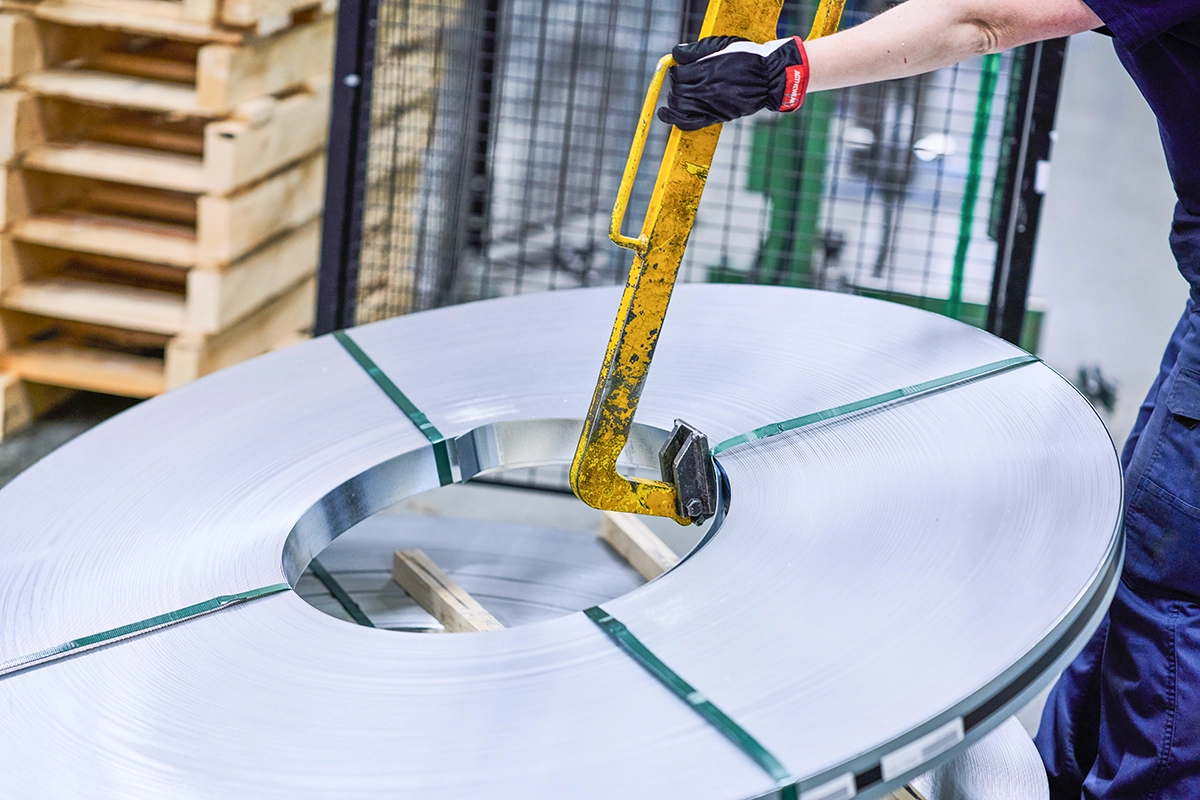
Z4 is a material that is incredibly corrosion resistant. The sheet is manufactured according to SS-EN 10346 with surface treatment and provides a hard and smooth, almost shimmering surface.
This surface treatment does not need to be protected when cutting and drilling (up to 2 mm material thickness). It is also possible to paint Z4.
The corrosion resistance corresponds to a hot-dip galvanized thickness of 85µm and is suitable for outdoor environments with high humidity and a large amount of air pollution but performs just as well in indoor environments.
Alloys
Stainless steel (RF)
Max corrosion class: | C5-I |
The stainless steel SS 2333/EN 1.4301/AISI 304 is an austenitic stainless steel that contains approximately 18% chromium and 8% nickel. It has good corrosion resistance in many environments and is intended for more aggressive environments indoors and outdoors, as well as environments with special hygiene requirements, e.g. food industries.
Acid-resistant (SF)
Max corrosion class: | C5-M |
The acid-resistant steel SS 2348/EN 1.4404/AISI 316L is a stainless steel, but with the addition of molybdenum (approximately 2-3%) which enhances its resistance to pitting and crevice corrosion, especially in chloride-containing environments. Suitable for marine environments, chemical industries, and other demanding environments.